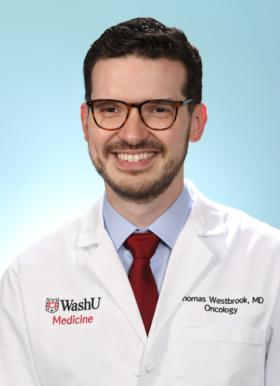
Address:
Division of Oncology
Mail Stop 8056-0029-11
Washington University
660 South Euclid Avenue
St. Louis, MO 63110
Admin:
Chad Benson
bchad@wustl.edu
- Genitourinary oncology, with clinical and research focus on the management of prostate, kidney, bladder, and testicular cancers.
My research focuses on understanding how prostate cancer develops resistance to anti-androgen therapies, combining genomic analysis with clinical data and advanced sequencing approaches. A central interest is lineage plasticity, an aggressive and somewhat unusual resistance mechanism in which the tumor undergoes a fundamental shift in its cellular identity to escape targeted treatment. I have proposed new approaches for identifying patients most likely to undergo this transformation. I am also studying drug combinations aimed at blocking lineage plasticity during the window when tumors begin to de-differentiate, before androgen blockage resistance is fully established. Separately, I am working to connect detailed genomic profiles with longitudinal clinical outcomes, with the goal of better understanding why patients respond so differently to androgen receptor pathway inhibitors, and why those responses vary in durability. Answering these questions requires tools like single-cell RNA expression profiling and epigenetic sequencing, which give us a more comprehensive view of what is happening biologically.
In kidney cancer, a major focus is on whether locally ablative approaches, particularly stereotactic ablative radiotherapy (SAbR), can be usefully combined with systemic therapies. One application we are actively studying is oligoprogression: situations where a small number of metastatic sites begin progressing while the rest of the disease remains controlled. Ablating those resistant clones can, in selected patients, allow continuation of a systemic regimen that would otherwise need to be stopped. We are also examining what happens when ablative therapies are used in combination to immune checkpoint inhibitors. The underlying idea is that these techniques may release tumor antigens in a way that amplifies the immune response and potentially improves outcomes beyond what either achieves alone.
Biosketch
Education
Post-graduate Training
- 07/2023-07/2020: Fellowship, Hematology/Oncology, University of Michigan, Ann Arbor, MI
- 06/2020-07/2017: Residency, Internal Medicine, Washington University in St. Louis, Barnes-Jewish Hospital, St. Louis, MO
Graduate
- 06/2017-08/2013: Doctor of Medicine (MD), University of Cincinnati College of Medicine, Cincinnati, OH
Undergraduate
- 05/2010-08/2006: Bachelor of Science in Chemistry with Honors, Michigan State University, East Lansing, MI
Academic and Promotion History
- present-08/2026: Assistant Professor of Medicine, Department of Medicine, Division of Oncology, Washington University in St. Louis, St. Louis, MO
- 07/2026-08/2023: Assistant Professor of Medicine, Department of Internal Medicine, Division of Hematology, Oncology and Cell Therapy, Rush University, Chicago, IL
- 06/2026-06/2024: Genitourinary Research Director, Rush MD Anderson Cancer Center, Chicago, IL
Professional Licensures and Certifications
- present-07/2026: License No. 2026030942, State of Missouri, Division of Professional Registration
- present-06/2023: License No. 036.165419, State of Illinois, Department of Financial and Professional Regulation
- present-2023: American Board of Internal Medicine, Medical Oncology
- present-2023: American Board of Internal Medicine, Hematology
- present-2020: American Board of Internal Medicine, Internal Medicine
Honors & Awards
- 6/2023: Best Fellowship Research Paper, University of Michigan
- 2016: Case Report Poster Winner, ACP Ohio/Air Force Chapter Meeting
- 2016: Alpha Omega Alpha Honor Medical Society (inducted third year)
- 2014: Research and Service Symposium Winner, University of Cincinnati College of Medicine
Professional Societies
- present-2020: American Society of Clinical Oncology
- present-2020: American Society of Hematology
- present-2017: Alpha Omega Alpha Honor Medical Society
- present-2014: American Medical Association
- present-2014: American College of Physicians